Introduction
If you've ever used an email verification tool, you've probably come across a result labeled:
Catch-All Email
For many marketers and sales teams, this raises an immediate question:
Is this email safe to send to or not?
Unlike clearly valid or invalid email addresses, catch-all emails exist in a gray area.
They aren't necessarily bad.
They aren't necessarily good.
They're simply uncertain.
Let's break down exactly what catch-all emails are and how you should handle them.
What Is a Catch-All Email?
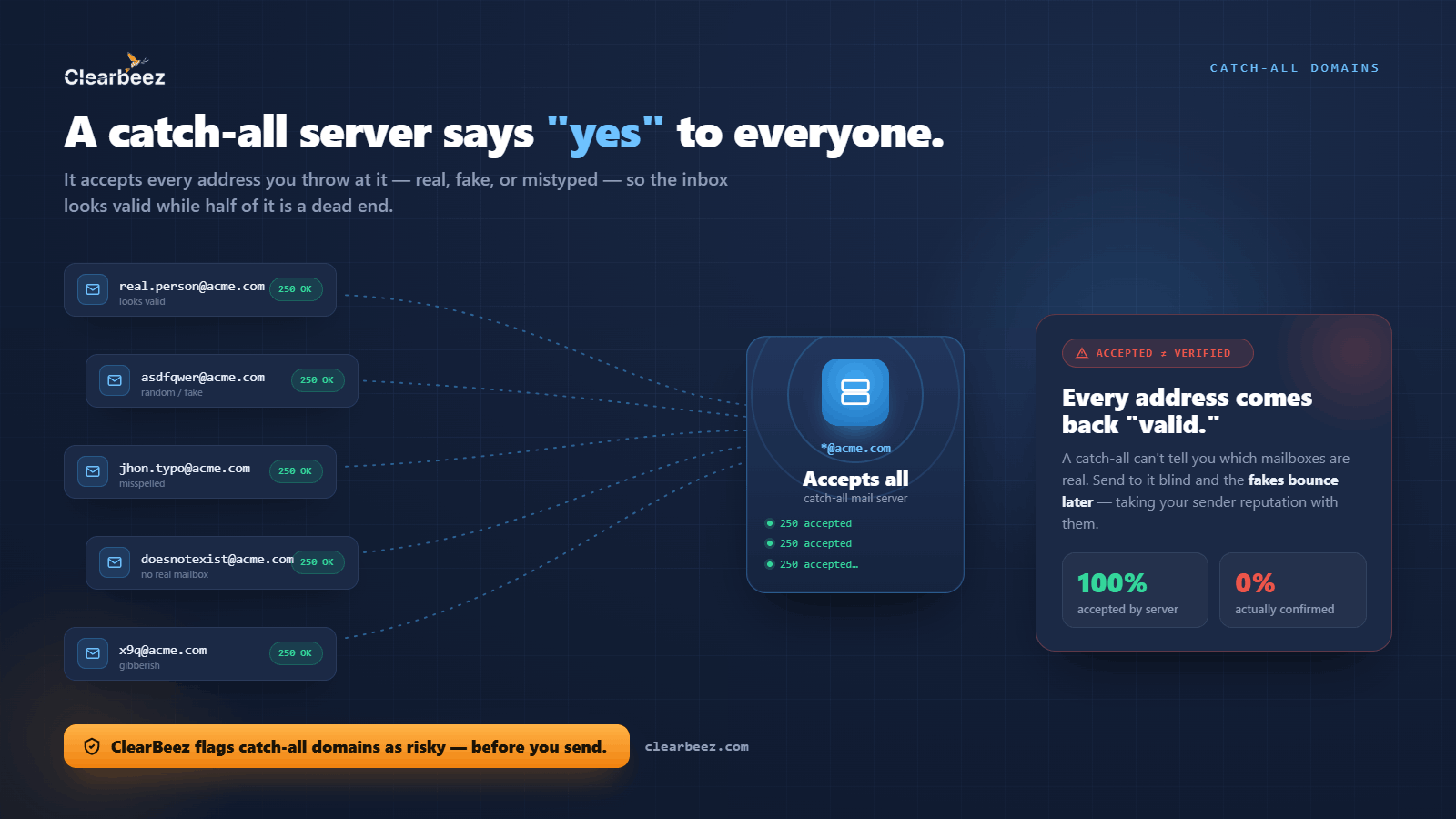
A catch-all email is part of a domain configured to accept emails sent to any address, even if that specific mailbox doesn't exist.
For example:
Imagine a company owns:
Normally:
✔ john@company.com → Valid
✔ support@company.com → Valid
❌ randomperson@company.com → Invalid
With a catch-all configuration:
✔ john@company.com → Accepted
✔ support@company.com → Accepted
✔ randomperson@company.com → Also Accepted
The mail server accepts the email regardless of whether the actual mailbox exists.
Why Do Companies Use Catch-All Domains?
There are several reasons.
Preventing Lost Emails
Companies don't want to miss important inquiries due to spelling mistakes.
For example:
might accidentally be typed as:
A catch-all configuration helps ensure the email is still received.
Managing Multiple Addresses
Large organizations often route all incoming messages through a central system before distributing them internally.
Legacy Server Configurations
Some companies have catch-all domains simply because they've been configured that way for years.
Why Are Catch-All Emails Difficult to Verify?
This is where things get interesting.
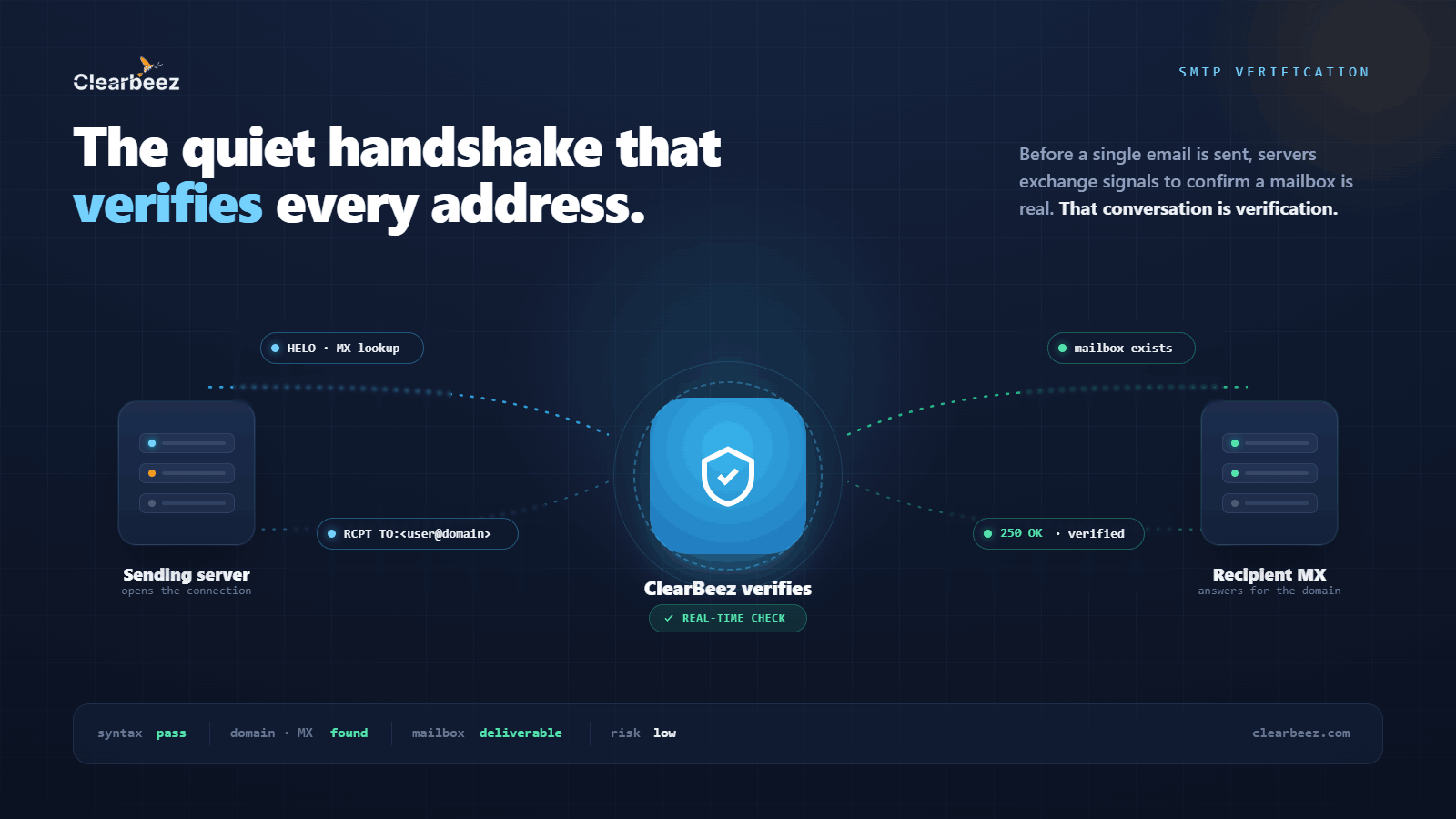
Most email verification systems check:
Email syntax
Domain validity
Mail server availability
Mailbox response
For standard email addresses, verification tools can often determine whether a mailbox exists.
But with catch-all domains, the server responds:
"Yes, I'll accept this email."
Even when the mailbox may not actually exist.
This makes it impossible to know with complete certainty whether a real person is behind the address.
Are Catch-All Emails Valid?
The honest answer:
Maybe.
Some catch-all addresses belong to real users.
Others do not.
That's why catch-all emails are typically classified as:
Risky
rather than:
Valid
Invalid
They sit somewhere in the middle.
Should You Send Emails to Catch-All Addresses?
This depends on your goals.
If You're Running Cold Outreach
Many sales teams still send emails to catch-all addresses.
Why?
Because some of these contacts are genuine prospects.
Ignoring every catch-all email could mean missing valuable opportunities.
If Deliverability Is Critical
If your sender reputation is your top priority, you may want to be more selective.
Sending large volumes to risky addresses can impact:
Engagement rates
Deliverability
Sender reputation
The Best Approach
Most experienced marketers don't automatically remove catch-all emails.
Instead, they:
✔ Segment them
✔ Monitor engagement
✔ Evaluate performance separately
This allows them to balance opportunity and risk.
What Risks Are Associated With Catch-All Emails?
Lower Engagement Rates
Many catch-all addresses aren't actively monitored.
Even if the email is accepted, nobody may ever read it.
Uncertain Deliverability
Some servers initially accept messages but later reject them internally.
This creates uncertainty around actual delivery.
Reduced Campaign Efficiency
Sending thousands of emails to unresponsive addresses can waste resources and skew campaign metrics.
How Can You Manage Catch-All Emails Effectively?
A few best practices:
Segment Catch-All Contacts
Keep them separate from fully verified contacts.
This allows you to monitor performance independently.
Focus on High-Value Prospects
If a catch-all address belongs to an important company or decision-maker, it may be worth the risk.
Monitor Engagement
Watch:
Opens
Replies
Clicks
Conversions
Real engagement is often the best indicator of quality.
Use Advanced Verification
Modern verification tools can provide additional signals beyond basic validation.
These signals help determine whether a catch-all email is worth contacting.
How ClearBeez Helps
ClearBeez identifies catch-all domains and classifies them separately from standard valid addresses.
Instead of simply marking an email as "valid" or "invalid," ClearBeez provides additional insights that help businesses:
Understand risk levels
Improve list quality
Make informed sending decisions
Protect sender reputation
This gives marketers and sales teams greater confidence when planning campaigns.
Frequently Asked Questions
Are Catch-All Emails Fake?
No.
Many catch-all emails belong to real users.
The challenge is that it's difficult to verify them with certainty.
Do Catch-All Emails Bounce?
Sometimes.
Some are successfully delivered.
Others may bounce later depending on how the receiving server handles incoming messages.
Should I Remove Catch-All Emails From My List?
Not necessarily.
The decision should depend on:
Campaign goals
Prospect value
Risk tolerance
Historical engagement
Are Catch-All Emails Bad for Deliverability?
Not automatically.
However, sending large volumes to low-quality catch-all addresses can affect deliverability over time.
Final Thoughts
Catch-all emails are one of the most misunderstood areas of email verification.
They aren't inherently good or bad.
They're simply uncertain.
The smartest approach is not to blindly include or exclude them.
Instead, evaluate them carefully, monitor performance, and make data-driven decisions.
When managed correctly, catch-all emails can still represent valuable opportunities without putting your sender reputation at unnecessary risk.